Avoid your inquiry is delay response, please enter your WhatsApp/Skype along with the message, so we can contact you at the very first time.
We will reply you within 24 hours. If for urgent case, please add WhatsApp/WeChat: ,. Or call directly.
One of the first concrete mixers ever was developed in 1900 by T.L. Smith in Milwaukee. The mixer already exhibited the still common basic construction with a tiltable conical drum (as double cone at that time) with blades. On February 9, 1904, the first portable concrete mixer was patented by Richard Bodlaender, an inventor from Breslau, Germany.[2] This concrete mixer was horse-drawn and called ‘Mortar Mixer’. It worked by replacing the front wheels with a large drum that held large paddles for mixing the cement.[3]1925, at least two mixers, built 25 years ago, were still in use (serial numbers 37 and 82). The Smith Mascot in essence has the same construction of the small mixers used today. In the 1920s, the T.L. Smith Company in Milwaukee built the world’s largest concrete mixers. Mixers of this company were used e. g. for the construction of the Wilson Dam (six 2-yard and two 4-yard mixers, at the time the largest single installation of the largest concrete mixers in the world), the first stadium of the Ohio State University and the Exchequer Dam.[4] Roscoe Lee was granted a patent in 1934 for his transit concrete mixer design. This design made it possible for new trucks to be turned into concrete mixers by using a crane to put a drum on the back of the truck.[3] It was less expensive than a cement truck dedicated to only carrying cement and allowed the trucks used to continue to be adapted for other things.[2] Concrete mixers have continued to advance. Recently, research detailing a forward simulation model of an energy-saving concrete mixer using hydraulic technology was released based on Matlab/Simulink technology.[5]
FA800 concrete mixer
For smaller jobs, such as residential repairs, renovations, or hobbyist-scale projects, many cubic yards of concrete are usually not required. Bagged cement is readily available in small-batch sizes, and aggregate and water are easily obtained in small quantities for the small work site. To service this small-batch concrete market, many types of small portable concrete mixers are available.
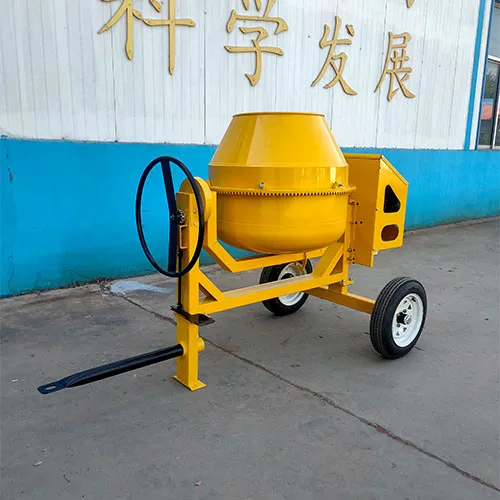
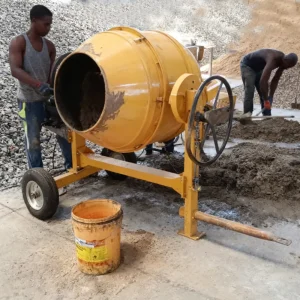
A typical portable concrete mixer uses a small revolving drum to mix the components. For smaller jobs the concrete made at the construction site has no time lost in transport, giving the workers ample time to use the concrete before it hardens.
Portable concrete mixers may be powered by gasoline engines, although it is more common that they are powered by electric motors using standard mains current.
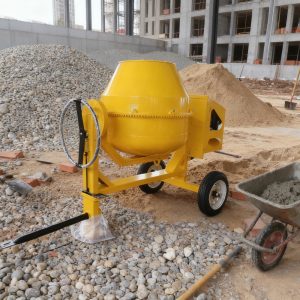
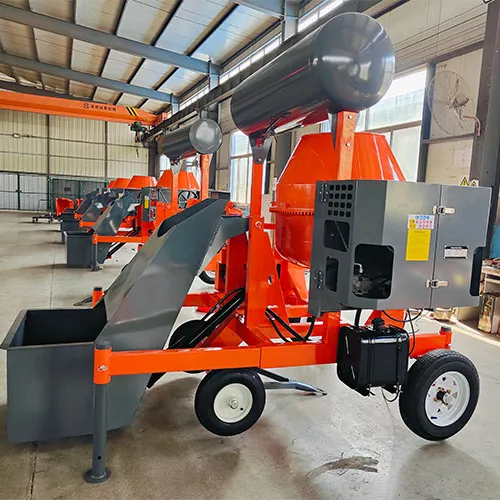
These concrete mixers are further divided based on their loading mechanism. Cement, sand and other aggregates are loaded in a hydraulically operated hopper and then poured into the mixing drum for final mixing. They can be unloaded by tilting the drum. In hand-feed concrete mixers, cement, sand and other aggregates are directly added to the mixing drum manually. Both of these types of concrete mixers are popular in construction activities in Africa, some Middle Eastern countries and in the Indian subcontinent.
Views: 148
 English English
 Spanish
 Portuguese
 French
 Arabic
 Dutch
Dutch Russian