Avoid your inquiry is delay response, please enter your WhatsApp/Skype along with the message, so we can contact you at the very first time.
We will reply you within 24 hours. If for urgent case, please add WhatsApp/WeChat: ,. Or call directly.
A successful construction project depends on a strong foundation as its primary element. Solid construction requires stable ground underneath, surfaces, sidewalks, and roads. Loose soil leads to the formation of cracks and dips and causes structural failures.
This is where a plate compactor becomes essential. This guide breaks down its parts, functions, and usage. This article contains pro tips to get the job done right.
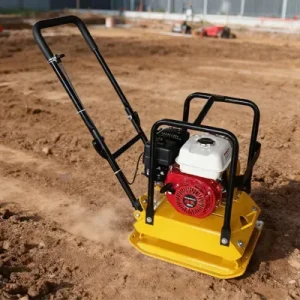
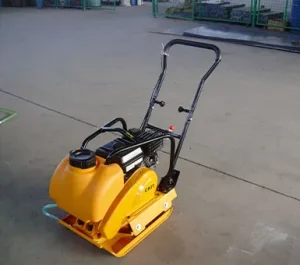
The plate compactor functions as a vibrating or Wacker plate to compress the soil. The machine uses a heavy vibrating plate to apply downward pressure on the ground.
The main goal is to densify materials by raising their content. It also decreases the risks of changes in material position or loss from elements. The failure rate of paving or foundation work becomes low after compaction.
Inadequate compaction causes structural failures. Roads may develop potholes. Pavers may sink or wobble. Soil with poor compaction becomes vulnerable to frost heave and water penetration.
Soil compaction activities boost soil-bearing capacity by 30% to 50%. Compaction-enhanced soils can bear higher structures and traffic loads.
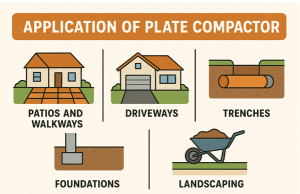
plate compactor
Soil compaction of soil is important in many structures, whether load-bearing or non-load-bearing. Yet, the following are common applications of compaction.
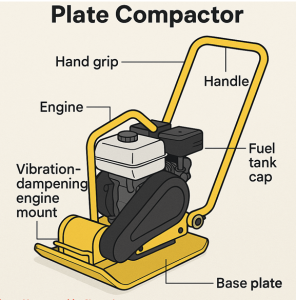
Keeping the importance of compaction in mind, let’s explore the tool for compaction. The most common equipment for compaction is a plate compactor. Now, here you can have a detailed glance at the plate compactor.
Engines of plate compactors range from 3 to 9 horsepower. Commercial models and standard gasoline engines use diesel. However, the majority of portable generators operate with 4-stroke gasoline motors. Most people trust the reliability of the Honda GX160 or Kohler models.
The engine powers the vibrator shaft and base plate. A larger engine means deeper and more powerful compaction.
Base plates are made of solid steel or cast iron. They usually range from 16 to 24 inches wide. Heavier plates produce stronger compaction but may be harder to manoeuvre.
Some plates are tapered or curved at the front edge. It helps with smooth movement across surfaces without digging in.
The eccentric vibrator mechanism handles producing vibration. It is located inside the base, the spinning shaft holds an off-balance weight. As it rotates, it generates vibration that shakes the entire machine.
This vibration is what forces particles of soil or gravel to lock together tightly.
Long handles reduce operator fatigue and improve control. Many compactors feature vibration-dampening grips to reduce hand-arm vibration syndrome (HAVS).
Controls typically include a throttle, an on/off switch, and sometimes a water spray valve. The water spray valve is for asphalt jobs.
The optional water tank is useful when compacting hot-mix asphalt. The applied water layer prevents the plate from acquiring trapped material. It extends the operational life of machines while enhancing their output finish quality.
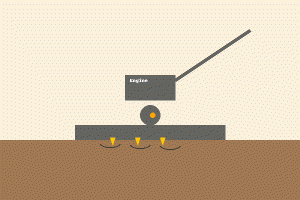
One must grasp the basics of soil compaction to understand the working mechanism. Here are some brief explanations for the working of plate compactors.
Soil contains solid components, water elements and air space. The major goal of compaction is to remove air between particles. It reduces the space between particles and increases density and strength.
During compaction, moisture plays a key role. The ideal compaction level is achieved with the optimum moisture content in the soil. It lies between 10%-20% for granular soils.
The off-centre rotating weights produce vertical vibration. This motion loosens the soil momentarily. Then the machine’s weight presses it downward.
Compactors vibrate at 2,000–6,000 vibrations per minute (VPM). Higher VPM is better for granular soils.
Each vibration is like a mini-impact. The force drives particles downward and eliminates voids. Machines exert anywhere from 1,000 to 4,000 pounds of centrifugal force.
As the vibration occurs, the machine “walks” forward. Operators follow behind, guiding the compactor in rows. Reversible models can move back and forth, reducing the need for turning in tight areas.
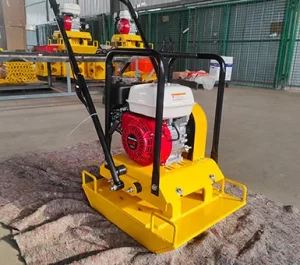
C100
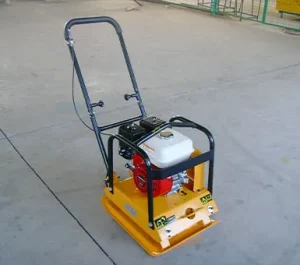
C90
C80
According to the purpose and specifications, there are two types of plate compactors.
Light and ideal for smaller jobs. Weigh between 100–200 lbs. Great for walkways, patios, and home landscaping.
Mid to heavy-duty machines weighing 300–1,000+ lbs. Used in commercial applications and roadwork. The ability to move in both directions increases efficiency.
With plate compactor each pass compacts about 2–4 inches. For deeper compaction, apply multiple layers.
Number of ideal passes varies but generally, 3–6 passes are enough. Use a soil test (Proctor test) for accuracy.
There is no difference between Wacker plate and plate compactor. “Wacker” is a brand. It’s now a general term used like “Band-Aid” for adhesive bandages.
Renting is ideal for occasional use. Costs range from $40–$80/day. If you need one regularly, buy a plate compactor unit for $400–$1,200.
C100
C80
C90
Views: 272
 English English
 Spanish
 Portuguese
 French
 Arabic
 Dutch
Dutch Russian