Avoid your inquiry is delay response, please enter your WhatsApp/Skype along with the message, so we can contact you at the very first time.
We will reply you within 24 hours. If for urgent case, please add WhatsApp/WeChat: ,. Or call directly.
| Term | Meaning | Relationship |
|---|---|---|
| Drum Volume (Geometric) | Total internal space of the mixing drum | The “260L–800L” rating typically refers to this |
| Input/Batch Volume | Total dry materials loaded | ≈ Drum Volume × 80% (maximum) |
| Output Capacity | Finished concrete produced per batch | ≈ Drum Volume × 65%~70% |
| Actual Usable Mix | Effective output utilization | ≈ Drum Volume × 2/3 |
⚠️ Critical: Most manufacturers rate their mixers by Concrete Mixer drum geometric volume, not actual output. The usable concrete per batch is roughly 2/3 of the stated drum volume.
Rated 260L Concrete Mixer drum → actual output ≈ 170–180L
Rated 350L Concrete Mixer drum → actual output ≈ 230–240L
Rated 500L Concrete Mixer drum → actual output ≈ 330–340L
Rated 800L Concrete Mixer drum → actual output ≈ 530–540L
Two fundamental reasons:
The drum operates at an inclination of approximately 60° from horizontal during mixing. At this angle:
Materials undergo a tumbling + cascading motion for thorough mixing of cement, sand, aggregate, and water
Below 50°, materials settle at the bottom — poor mixing
Above 70°, materials are thrown too high — spillage and wasted energy
60° is the engineering-proven optimal angle
When tilted, the effective working zone is only a portion of the drum’s axial projection. At least 1/3 of the drum volume cannot participate in effective mixing — this is the physical basis of the “2/3 rule.”
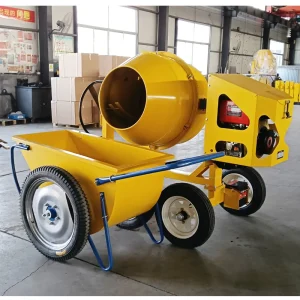
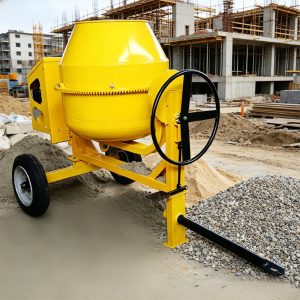
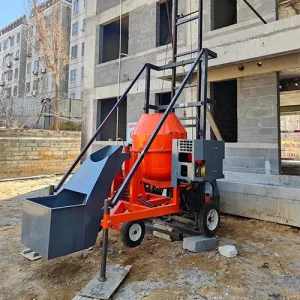
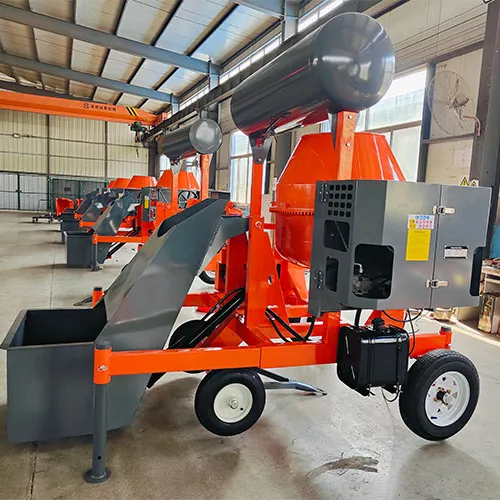
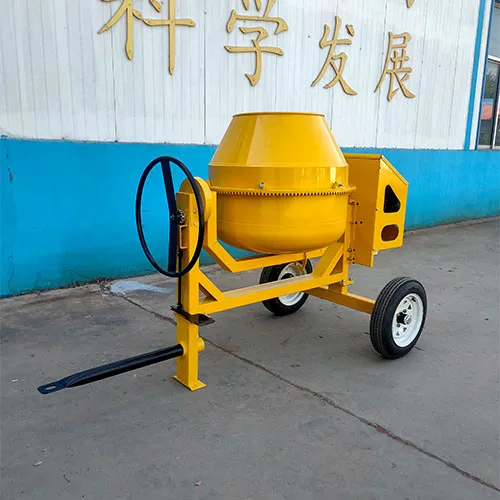
Concrete Mixer, Portable Concrete Mixer, Small Concrete Mixer. Mini Concrete Mixer, Machine, Tools
Even if the drum were horizontal (which never happens in practice), at least 20% empty space is required for the concrete to tumble and cascade. Otherwise, materials are simply “carried along” rather than “mixed.”
Combined effect: Tilt-induced volume loss (≈1/3) + tumbling headspace (≈20%) = actual output ≈ geometric volume × 80% × 80% ≈ 65% — roughly 2/3.
✅ Your statement “actual mixing capacity is at most 2/3 of the drum capacity” is 100% accurate and industry-recognized.
II. 260–800L (Drum Volume) — Real-World Application Mapping
Based on “actual output ≈ drum volume × 2/3”:
260L ≈ 170L ~0.7 bag (35kg) Minor repairs, home DIY, fence posts 350L ≈ 230L ~1 bag (50kg) Rural construction, small road patching 500L ≈ 330L ~2 bags (100kg) General building, medium contractor teams 800L ≈ 530L ~3 bags(150kg) Major projects, batching plant support 💡 Industry practice: When a worker says “I need a 350 mixer,” they mean 350L drum volume — actual output is ~230L per batch. Always clarify this with the seller. Reputable brands often label both (e.g., “Model 350L / Output 230L”), but smaller manufacturers may only list the maximum volume.
Laizhou Qike Concrete Mixer Supplier
III.Operating Tips for Drum Tilt Angle
During mixing: Maintain 60° tilt — optimal for uniformity. Do not reduce the angle just to load more material.
During discharge: Increase tilt to 45°–50° (more vertical) for natural flow-out.
Never: Fill the drum to the brim before starting — it causes uneven mixing, shortens gearbox life, and may burn out the motor.
🔧 Pro tip: Mixers with self-discharge capability can reach 70°–75° tilt during unloading for more complete discharge. Look for “dual-angle” designs (mixing angle + discharge angle) when purchasing.
Correction Summary
Original Content Revised Version Rated capacity ≈ actual output Rated capacity × 2/3 ≈ actual output Tilt angle not mentioned 60° is the optimal mixing angle — the core reason for the 2/3 rule Vague capacity advice Clear distinction between “drum rating” and “usable output FD-3 Model Concrete Mixer
Views: 97
 English English
 Spanish
 Portuguese
 French
 Arabic
 Dutch
Dutch Russian