Avoid your inquiry is delay response, please enter your WhatsApp/Skype along with the message, so we can contact you at the very first time.
We will reply you within 24 hours. If for urgent case, please add WhatsApp/WeChat: ,. Or call directly.
On construction sites, few working relationships are as fundamental and enduring as that between the concrete mixer and the wheelbarrow. Though they are vastly different in size, power, and function, they form a perfect working pair—one the stationary heart of production, the other the agile limbs of delivery. Together, they bridge the critical gap between mixing and placement, ensuring that concrete moves from a raw heap of ingredients to its final resting place with efficiency, continuity, and minimal waste.

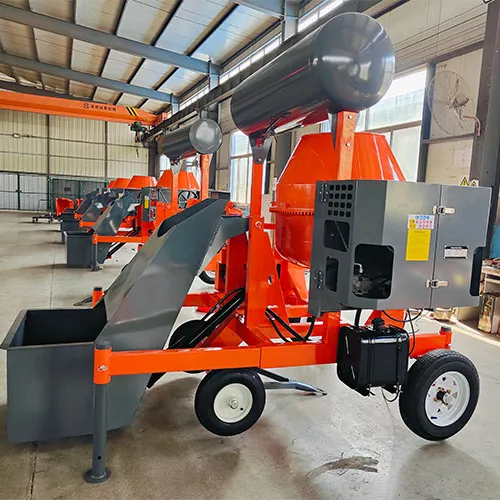
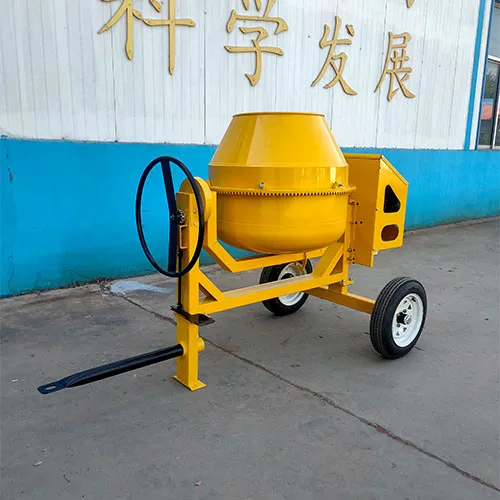
The concrete mixer is, in many ways, the site’s dedicated chemist and batch plant rolled into one. Its rotating drum, powered by a diesel engine or electric motor, tirelessly tumbles measured amounts of cement, coarse gravel, fine sand, and water until they are transformed into a homogeneous, workable mass. This is no casual stirring; the mixer must achieve a consistent color, texture, and slump across every cubic foot of material, because even a slight variation in water-cement ratio can compromise the strength and durability of the finished structure. Modern mixers often come with on-board water tanks, automatic weighing systems, and even digital timers to ensure precision, but at its core, the machine’s job remains the same: to produce a uniform, predictable product that meets strict engineering specifications. Whether it is a small portable unit churning out half a bag of mortar or a large tilt-drum mixer discharging several yards of structural concrete, the mixer operates as a fixed node—usually stationed near the material stockpile, the cement silo, and the water supply—because moving it once it is loaded is inefficient and impractical.

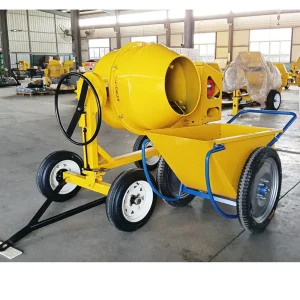
This is precisely where the wheelbarrow enters the picture, and its role is every bit as vital as the mixer’s. While the mixer is rooted in place, the wheelbarrow is born to roam. With its single front wheel, two handles, and a deep steel or polypropylene tray, it is the ultimate solution for short-haul, stop-and-go transportation across uneven, congested, and ever-changing job sites. A skilled laborer can guide a fully loaded barrow—weighing anywhere from 60 to over 100 kilograms—up a narrow plank ramp to a second-floor slab, around exposed rebar, through muddy ruts, and into tight corners where no truck or pump could ever reach. The wheelbarrow does not just carry concrete; it carries it in manageable, human-scale batches, allowing the crew to match the pace of delivery to the pace of placing and finishing. If the mixer produces a continuous stream of fresh concrete, the wheelbarrow turns that stream into a series of precise, targeted deposits—a few barrows for a column footing, a dozen for a grade beam, a single one for a patch repair.
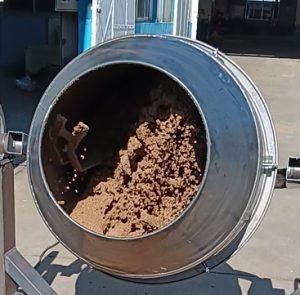
What makes this partnership truly effective, however, is their mutual dependency and the rhythm they create together. The mixer’s output must be synchronized with the wheelbarrow’s turnaround time; if the barrows are too slow, the concrete begins to stiffen inside the drum, risking a dry, unworkable mix; if they are too fast, the mixer cannot keep up, and laborers end up waiting, losing momentum. Experienced site teams develop an intuitive cadence—one worker shovels aggregates and operates the mixer, another fills each barrow with just the right amount (not too full to spill, not too light to waste trips), and others ferry and pour. This choreography minimizes segregation, because the concrete is discharged directly from the mixer into the barrow and then immediately transported, reducing the number of transfers that can cause aggregate settling. It also maximizes flexibility: when a design change or an unforeseen obstacle shifts the pour location, the wheelbarrow adapts instantly, while the mixer simply continues its rotation, ready to fill the next load.
Moreover, this pair embodies a broader lesson in construction logistics: the value of combining centralized efficiency with decentralized agility. The mixer is the economy of scale—it processes large volumes with consistent quality, using mechanical power to eliminate the back-breaking labor of hand-mixing. The wheelbarrow is the economy of scope—it delivers that quality precisely where it is needed, when it is needed, without requiring expensive pumps, pipelines, or crane-and-bucket rigs. Together, they cover the full spectrum from production to placement, and they do so with remarkable reliability. They are also remarkably forgiving: a mixer can handle different mix designs with a simple adjustment of water and aggregates, and a wheelbarrow can carry mortar, grout, or even debris when concrete work is done.
Of course, this partnership is not without its demands. Wheelbarrow routes must be kept clear of obstructions, ramps must be sturdy and non-slip, and the mixer must be regularly cleaned to prevent hardened concrete from locking its blades. Yet these maintenance tasks are small prices to pay for a system that has proven itself on countless projects, from suburban driveways to high-rise foundations. In an age of ever-larger machinery and automated screeding robots, the concrete mixer and the wheelbarrow remain the everyman’s tools—accessible, repairable, and perfectly matched to the chaotic, human-scaled reality of active construction. They do not compete; they complement. The mixer provides the muscle and consistency, the wheelbarrow provides the reach and responsiveness, and together, they turn a pile of dusty ingredients into the solid bones of the built world.
Views: 38
 English English
 Spanish
 Portuguese
 French
 Arabic
 Dutch
Dutch Russian